
Manufacturers don’t usually lose money because of expensive machinery. The machinery is expected to cost what it costs. What actually eats into margins, quarter after quarter, is smaller than that — a sealing failure that shuts an entire production line down over a part that costs a fraction of what the equipment around it does.
Downtime. Contamination that turns a batch into a write-off. Air leakage that’s been quietly wasting energy for months before anyone noticed. Pressure loss that shows up as a failed inspection at the worst possible time. All of it, more often than engineers expect, traces back to a seal that was never actually engineered for the equipment it went into.
This is exactly the gap custom inflatable seals built to close — and for U.S. manufacturers under real pressure to cut downtime and control lifecycle costs, that gap is worth understanding properly.
What Are Custom Inflatable Seals?
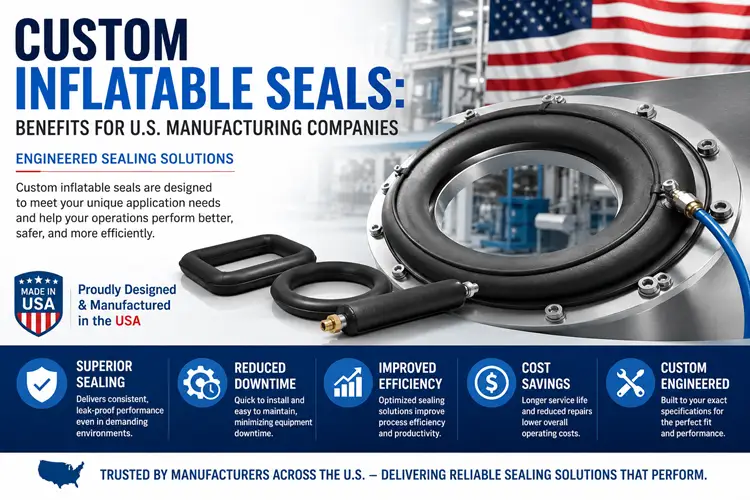
An inflatable seal is a hollow elastomer gasket that stays deflated until it’s actually needed. Feed it compressed air and it expands to create even sealing force around a door, chamber, or opening. Release the pressure and it retracts completely, so moving equipment isn’t dragging against a seal that’s compressed all the time.
That “custom” part matters more than it might seem. A standard, catalog inflatable seal is built to an average profile that fits a lot of equipment reasonably well and none of it perfectly. A custom-engineered seal is built to your equipment’s exact groove, exact pressure requirements, and exact operating environment — which is what allows it to deliver genuinely uniform sealing force instead of a close approximation.
Why More U.S. Manufacturers Are Moving to Custom Inflatable Seals
Several forces are pushing this shift at once. Automation keeps expanding, and automated equipment cycles far more frequently than equipment run manually — which wears out a poorly matched seal much faster. Labor shortages mean fewer hands available for reactive maintenance, so equipment needs to fail less often, not just get fixed faster when it does. FDA and other regulatory requirements keep tightening, particularly in pharmaceutical and food processing. Energy efficiency has become a real line item, not an afterthought, and a leaking seal is a quiet but constant energy cost. Predictive maintenance programs are becoming standard rather than optional. And Industry 4.0 adoption keeps raising the bar for how reliably equipment needs to perform without direct supervision.
Every one of these trends points in the same direction: toward equipment that needs to run longer, more predictably, with less manual intervention — exactly the conditions where custom engineering earns back its upfront cost.
Top Benefits of Custom Inflatable Seals
Superior leak prevention. A custom profile matched to the exact groove and surface it’s sealing against closes gaps a standard seal simply can’t compensate for.
Reduced downtime. Seals engineered for the actual pressure, temperature, and cycle count of the application fail far less often — and less frequently means less unplanned line stoppage.
Longer equipment life. Because the seal isn’t fighting friction or misalignment it wasn’t designed for, wear on surrounding components — doors, actuators, housings — drops too.
Better product quality. In contamination-sensitive environments, a seal that actually holds its rated performance protects product integrity in a way a “close enough” standard part can’t guarantee.
Lower maintenance costs. Fewer failures and longer service intervals mean less time and money spent on seal-related maintenance overall.
Custom engineering for OEM equipment. Seals built around a specific machine design integrate cleanly instead of requiring the equipment to be redesigned around a standard part.
FDA and cleanroom compatibility. Custom material selection makes it possible to meet FDA compliance and cleanroom requirements precisely, rather than settling for whatever compliant material happens to come in a standard size.
Improved operator safety. A seal engineered to actually hold pressure and temperature ratings reduces the risk of steam, gas, or pressure escaping where it shouldn’t.
Applications Across U.S. Manufacturing
Custom inflatable seals show up across a genuinely wide range of industries: food processing, medical devices, semiconductor manufacturing, battery production, automotive, chemical processing, packaging machinery, aerospace, defense, laboratory equipment, industrial automation broadly, vacuum chambers, environmental chambers, and autoclaves.
What connects nearly all of these is the same underlying need — equipment that opens and closes repeatedly, needs an airtight seal when closed, and can’t afford a sealing failure without real consequences, whether that’s contamination, safety risk, or a validation problem.
Choosing the Right Material
Even the best custom geometry underperforms if the material is wrong for the application.
| Material | Temperature | Chemical Resistance | Compression Set | FDA Compliant | Ozone/Weather |
| Silicone | -60°C to 230°C | Moderate | Low | Yes | Excellent |
| EPDM | -50°C to 150°C | Good (steam/water) | Low | Limited | Excellent |
| NBR | -30°C to 120°C | Strong (oils) | Moderate | No | Poor |
| FKM (Viton) | -20°C to 200°C | Excellent | Very low | Limited | Good |
| Neoprene | -40°C to 120°C | Moderate | Moderate | No | Good |
| Natural Rubber | -40°C to 80°C | Poor | Moderate | No | Poor |
Silicone tends to win for FDA and cleanroom work. EPDM covers steam and general weathering economically. NBR handles oil exposure that would degrade the others. Viton takes on the most aggressive chemical and high-temperature environments. The right choice always comes down to matching this table to what the seal will actually be exposed to, not defaulting to whatever was used last time.
Custom Engineering Considerations
Getting a custom inflatable seal right involves more variables than most engineers expect on the first pass: inflation port placement and design, groove geometry matched to the exact mounting surface, required operating pressure with a real safety margin, dimensional tolerances that actually fit the equipment, expected cycle life over the machine’s service life, bonded joint quality where the seal profile isn’t a single continuous extrusion, how molded corners are handled without creating weak points, and air fitting compatibility with the equipment’s existing pneumatic system.
Missing any one of these tends to show up later as a seal that technically fits but doesn’t perform — which is often more frustrating than a seal that obviously doesn’t fit at all.
How Custom Inflatable Seals Reduce Total Cost of Ownership
This is where the cost-savings case actually gets made, and it’s worth being precise about it rather than hand-waving.
A custom inflatable seal costs more upfront than a standard catalog part — that’s real, and worth acknowledging honestly. But total cost of ownership isn’t just the purchase price. It’s purchase price plus maintenance frequency, plus downtime cost every time a seal fails, plus the energy wasted by a seal that’s slowly leaking, plus how often the part needs replacing, all weighed against how much machine uptime the equipment actually delivers over its working life.
Run those numbers over a few years instead of a single purchase order, and custom engineering usually wins clearly — often by a wide margin, once a single avoided shutdown is factored in against the incremental cost difference on the part itself.
Signs Your Equipment Needs Custom Inflatable Seals
A few warning signs tend to show up before a full failure: air leakage that keeps recurring no matter how many times the seal gets replaced, dust or contaminants finding their way in despite a “sealed” enclosure, gradual pressure loss that wasn’t there when the equipment was new, seals that need replacing far more often than seems reasonable, doors that don’t align consistently, or uneven compression across the sealing surface.
Any one of these, showing up repeatedly, is usually a sign the standard part in place was never actually the right fit.
Custom vs. Standard Inflatable Seals: When Is Customization Worth It?
Not every application needs a custom seal — and pretending otherwise would be dishonest. For low-cycle, low-consequence equipment, a standard part is often perfectly adequate.
Customization earns its cost when the application involves high cycle counts, contamination-sensitive processes, regulatory compliance requirements, unusual dimensions or groove geometry, or a history of repeat seal failures with standard parts. If your equipment checks two or more of those boxes, custom engineering is very likely the more economical choice over the machine’s working life — even though it costs more on day one.
OEM Design Checklist: What to Share Before Requesting a Custom Seal
Getting an accurate engineering recommendation starts with sharing the right information upfront. At minimum, a manufacturer needs: the groove or mounting dimensions, operating pressure and any pressure spikes the system experiences, temperature range across the full operating cycle, chemical or media exposure, expected cycle frequency and duty cycle, any regulatory requirements like FDA compliance, and ideally a drawing or CAD file of the actual mounting surface.
The more complete this information is upfront, the fewer engineering iterations it takes to land on the right design — which saves time on both sides.
Common Design Mistakes
The same handful of mistakes show up repeatedly in custom seal requests: groove dimensions that don’t match the actual seal profile, inflation pressure specified without a real safety margin, material selected based on general category rather than actual chemical exposure, and compression requirements that weren’t verified against the seal’s real deflection range.
Catching these during the design phase is far cheaper than catching them after the seal is already in production and failing early.
Why OEMs Choose Experienced Manufacturers
Not every supplier is actually equipped to handle custom engineering well. What separates a genuine engineering partner from a catalog supplier: real compound development capability rather than just selecting from pre-made materials, in-house tooling instead of outsourced mold production, actual pressure and performance testing, rapid prototyping to validate a design before committing to full production, real quality control processes, and engineers who can explain trade-offs rather than just taking an order.
Why Western Polyrub Is Trusted by Global OEMs
Western Polyrub India Pvt. Ltd. brings more than 30 years of custom inflatable seal manufacturing experience to exactly this kind of engineering problem — custom rubber compound development, FDA-compliant materials, in-house fabrication and tooling, genuine performance testing, real engineering support during the design phase, and export capability serving OEMs across the U.S. and globally.
The value isn’t in a sales pitch. It’s in a manufacturer who understands why a seal fails well enough to design around it before it ever ships.
Frequently Asked Questions
What is a custom inflatable seal? A hollow elastomer seal engineered to a specific equipment’s exact groove, pressure, and material requirements, rather than a standard catalog profile.
How do inflatable seals work? They expand with compressed air to create sealing force only when needed, then retract fully, avoiding the friction and wear of a constantly compressed gasket.
What industries use inflatable seals? Pharmaceutical, food processing, semiconductor, medical device, aerospace, chemical processing, battery manufacturing, and general industrial automation, among others.
Are inflatable seals better than traditional rubber seals? For dynamic, cycling applications, generally yes. For simple static joints, a traditional gasket is often the more practical, cost-effective choice.
How long do inflatable seals last? It depends on material, pressure, and cycle frequency, but properly specified custom seals typically far outlast standard parts under the same conditions.
Which material is best for inflatable seals? It depends on the application — silicone for FDA and high-temperature use, EPDM for steam and weathering, NBR for oils, and Viton for aggressive chemicals.
Can inflatable seals withstand high temperatures? Yes, when the correct material is specified — silicone and Viton both handle sustained high heat well.
Are inflatable seals FDA compliant? FDA-compliant silicone inflatable seals are widely available and commonly used in food and pharmaceutical applications.
How much pressure is required for inflatable seals? It varies by design and should be specified based on the sealing gap and duty cycle, always with a safety margin below the seal’s rated burst pressure.
Can inflatable seals be customized? Yes — profile, material, inflation pressure, and mounting configuration can all be engineered around specific equipment.
What causes inflatable seal failure? Most commonly the wrong material, incorrect pressure, poor groove design, or defaulting to a standard part where a custom one was actually needed.
How do you maintain inflatable seals? Regular visual inspection, pressure monitoring, and replacement based on observed wear rather than a fixed calendar schedule.
What is the difference between silicone and EPDM inflatable seals? Silicone offers a wider temperature range and FDA compliance suited to pharmaceutical use, while EPDM offers strong steam and weather resistance at a lower cost.
Can inflatable seals be used in vacuum applications? Yes — inflatable seals are commonly used in vacuum chambers, where they compensate for machining tolerances and maintain vacuum integrity reliably.
How much does a custom inflatable seal cost compared to a standard one? Custom seals typically cost more upfront, but usually deliver a lower total cost of ownership once maintenance, downtime, and replacement frequency are factored in.
Get an Engineering Recommendation, Not Just a Quote
Every custom inflatable seal starts the same way: discuss your application, share a drawing or dimensions, and outline your actual operating conditions — pressure, temperature, chemical exposure, and cycle frequency. From there, an experienced manufacturer can give you a real engineering recommendation instead of just pointing you toward the closest catalog match.
Ready to solve a recurring sealing problem or design sealing into a new piece of OEM equipment? Share your application details with Western Polyrub and get an engineering recommendation built around your equipment, not a generic part number.